

Leadership and Dancing: What Movement Teaches Us About Visibility, Stress, and Authority
By Mona Amini, MD, MBA
Leadership is often discussed in terms of strategy, communication, decisiveness, and executive presence. We talk about vision, influence, and performance. We talk about how leaders speak, how they think, and how they make decisions under pressure. What is discussed far less often is that leadership is also profoundly physiological. Before leadership is interpreted by others, it is experienced in the body.
Any time a person stands in front of a boardroom, leads a team meeting, speaks on stage, hosts an event, shares an opinion publicly, or steps into a visible role, the nervous system is processing something fundamental: I am being observed. I am being evaluated. For the human brain and body, social evaluation can register as a meaningful stressor. This is not a character flaw. It is part of our biology. Research has shown that tasks involving social evaluative threat reliably increase cortisol, reinforcing the idea that being watched and judged can activate the stress response in a measurable way.
This matters because stress changes performance. Under heightened activation, cognitive flexibility narrows. Working memory can become less efficient. Emotional reactivity often increases. Risk perception can shift. A person may suddenly become more guarded, less expressive, and more focused on self-protection than on creative or strategic thinking. In other words, when visibility feels threatening, leadership capacity can constrict.
The Body Contracts Before the Mind Does
Many high-achieving professionals unconsciously manage visibility through physical contraction. They tighten their posture. They minimize their gestures. They restrict facial expression. They hold tension in the shoulders, chest, jaw, or hands. They try to appear controlled, composed, and unshakable. In many professional settings, this kind of constriction is rewarded and mistaken for authority.
But the body is not separate from confidence. It helps shape it.
Research in embodied cognition suggests that bodily states influence emotional processing and self-perception. The body does not simply reflect how we feel. It also feeds back into the experience itself. If someone’s default response to being seen is to physically contract, that constriction can reinforce an internal state of vigilance, guardedness, or inhibition. Over time, the body can learn to associate visibility with tension rather than safety.
This is one reason so many capable people feel unlike themselves when they are in high-visibility moments. They may know the material. They may be intelligent, talented, and prepared. But when the body enters a threat state, presence changes. Expression changes. Access to ease changes.
Why Dance Offers a Powerful Lens
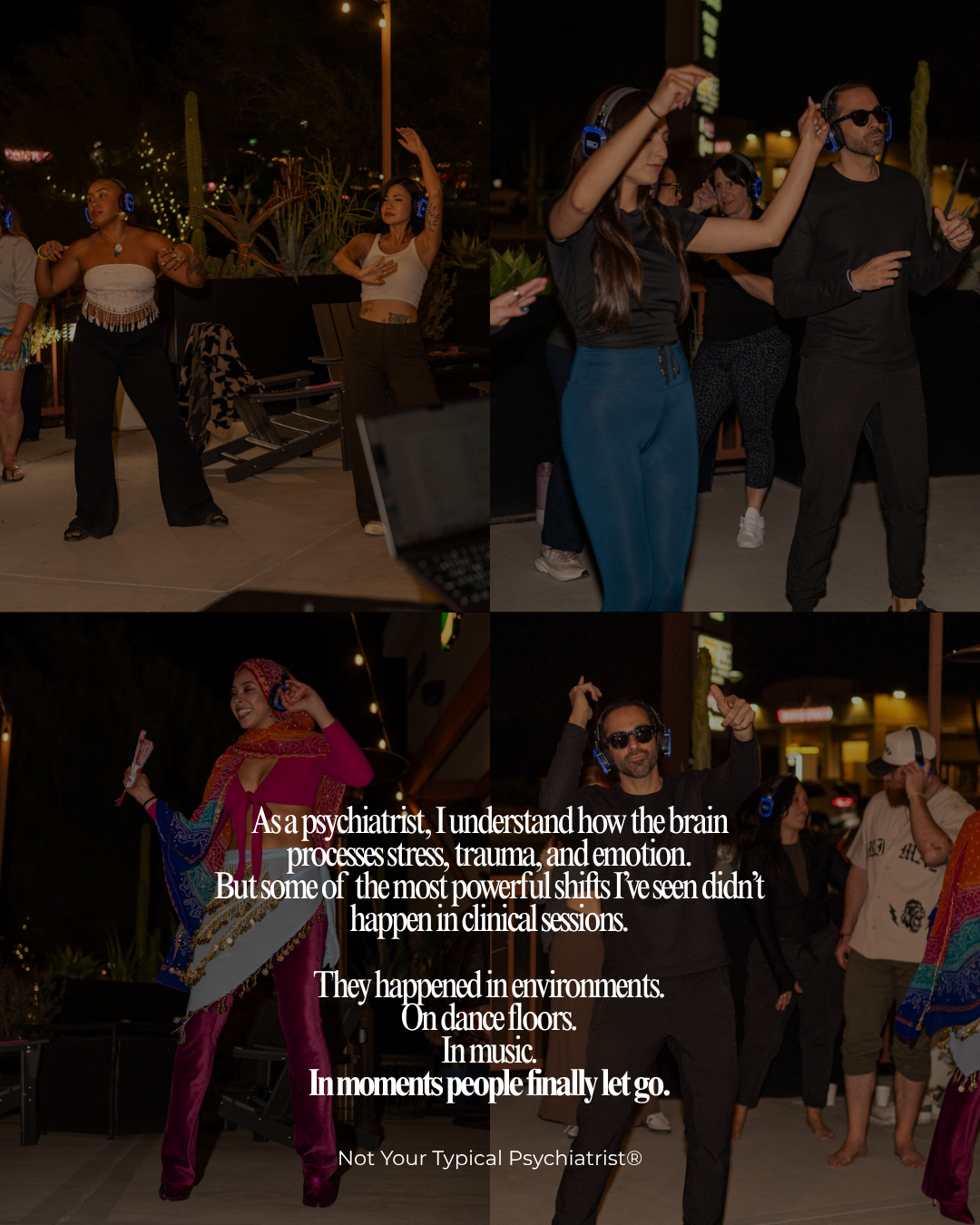
Dance offers an interesting counterpoint to this dynamic because it brings visibility, movement, and expression into the same frame. Dancing, especially when done without excessive self-monitoring, requires a person to take up space. It asks them to move rather than freeze, to be seen without collapsing inward, and to remain connected to rhythm, sensation, and flow even under observation.
That makes dance more than recreation. It can function as embodied exposure.
In psychology, repeated exposure to previously threatening stimuli can reduce physiological reactivity over time. This principle is foundational to behavioral therapies that help people increase tolerance for discomfort and reduce avoidance. While dance is not a replacement for therapy, it can serve as a compelling real-world practice ground for some of the same capacities. It allows the nervous system to experience visibility in a different way.
Rather than equating being seen with danger, the body begins to gather new evidence. It learns that movement is survivable. Expression is survivable. Taking up space is survivable. Over time, that matters.
Research has also shown that dance and dance movement interventions are associated with improvements in self-esteem, mood, and body image across a variety of populations. The mechanism is not mystical. It is behavioral, emotional, relational, and physiological. The body begins to associate movement with agency rather than self-consciousness. Presence starts to feel less performative and more embodied.
Confidence Is Often Tolerance for Being Seen
Confidence is frequently described as a personality trait, something a person either has or does not have. But in practice, confidence often looks more like a learned tolerance for visibility. Many people who appear calm, grounded, and authoritative under scrutiny are not necessarily free from stress reactivity. More often, they have accumulated repeated experiences of being seen, evaluated, and challenged while staying functionally regulated.
This changes how we think about authority.
Authority is not always loudness. It is not overcompensation. It is not a rigid performance of control. True authority often comes across as regulated presence under observation. It is the ability to remain connected to oneself while others are watching. It is the ability to hold shape without shutting down.
Embodied practices such as dance, movement, rhythm-based experiences, and somatic regulation can help build this skill. They offer opportunities to rehearse visibility in ways that are less abstract and more lived. They also remind us that self-trust is not just cognitive. It is sensory.
The New Context for Movement and Leadership
The cultural role of dance and movement has evolved. It is no longer confined to clubs, nightlife, or entertainment. Movement is increasingly showing up in corporate wellness settings, leadership retreats, creative community spaces, and high-performance environments. That shift reflects something important: we are beginning to understand that cognitive performance cannot be separated from physiological regulation.
The leaders of the future will not only need strong ideas. They will need nervous systems capable of tolerating uncertainty, scrutiny, change, and complexity without chronic contraction. They will need to know how to recover. They will need to know how to stay present. They will need to know how to use their body as an ally rather than treating it as something to override.
This is especially relevant in a world where visibility is constant. Many professionals are now expected to lead in person, online, on camera, across platforms, and across audiences. That kind of sustained evaluation requires more than intellectual skill. It requires capacity.
Implications for Organizations
If organizations want leaders who are adaptive, emotionally regulated, creative, and effective under pressure, leadership development must extend beyond slide decks, scripts, and surface-level communication training. It must include a more sophisticated understanding of stress physiology, nervous system regulation, embodied presence, and visibility tolerance.
That does not mean every organization needs a dance floor. It does mean we need broader thinking about how leadership is built.
Leadership training should include space for people to understand what happens in their body under evaluation. It should normalize the stress response rather than shaming it. It should create opportunities for behavioral exposure, self-awareness, and regulation skills that support authentic presence.
At the intersection of psychiatry, performance psychology, music, and culture, this conversation becomes especially compelling. Structured embodied experiences may have far more relevance for leadership development and wellness design than traditional professional culture has acknowledged. The future of leadership training may not be purely cognitive. It may be increasingly physiological, relational, and sensory-aware.
Because when the body learns that visibility is not a threat, authority begins to feel less like performance and more like alignment.
Give yourself permission to lead with presence, not pressure.
References
Dickerson SS, Kemeny ME. 2004. Acute stressors and cortisol responses: A theoretical integration and synthesis of laboratory research. Psychological Bulletin.
Niedenthal PM. 2007. Embodying emotion. Annual Review of Psychology.
Koch SC, Kunz T, Lykou S, Cruz R. 2014. Effects of dance movement therapy and dance on health-related psychological outcomes: A meta-analysis. The Arts in Psychotherapy.
Call to Action:
If you are rethinking leadership through the lens of mental wellness, embodied confidence, and whole-person performance, this is the conversation to keep exploring. At Mon’Vie Mind Wellness®, we are interested in how psychology, physiology, music, movement, and emotional regulation come together to shape the way we lead, heal, and show up in the world. Explore our offerings, stay connected for upcoming experiences, and follow along for more insights on leadership, nervous system health, and empowered living.
